Contemporary Curve: A Handcrafted Script Font for Makers
It started with a candle label — one I’d sketched by hand, then scanned, then spent twenty minutes trying to replicate in Illustrator. The client wanted “soft but intentional,” “warm but polished,” and “uniquely theirs.” I opened my font library, scrolled past the usual suspects, and landed on Contemporary Curve. Instantly, that little “aha” — the kind that happens when a typeface doesn’t just sit on the page, but breathes with your design.
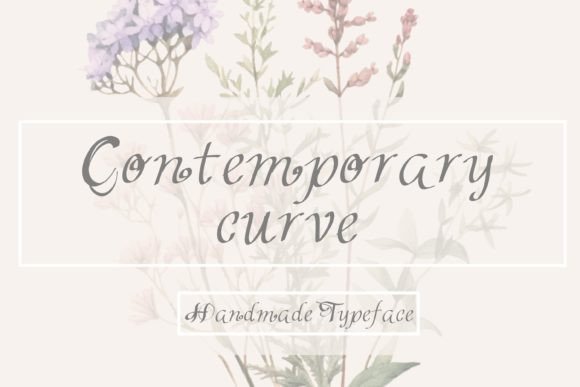
Contemporary Curve is a handcrafted script font from the Script Amp collection, designed with elegant, flowing curves and delicate decorative embellishments. It’s not overly ornate, nor is it minimalist to the point of sterility. Instead, it strikes that rare balance: modern enough for a boutique candle brand, graceful enough for a wedding invitation suite, and expressive enough to feel personal on a handmade planner sticker or a seasonal printable wall art piece.
I first tested it on a set of soy wax candle labels — 2-inch round stickers printed on matte kraft paper. With its generous x-height and open counters, Contemporary Curve held up beautifully at small sizes. The rounded terminals softened the edges without sacrificing clarity, and the subtle swashes (especially on the uppercase ‘S’, ‘Y’, and ‘R’) added just enough character to catch the eye on a crowded shelf — or in a scroll-heavy Etsy listing.
What makes it especially useful for makers is how naturally it transitions across formats. On physical goods like cotton tote bags or ceramic mugs, its smooth curves translate well to vinyl cut files and sublimation previews. In digital printables — think planner undated pages, gratitude journal headers, or printable quote cards — it lends warmth without overwhelming the layout. And for wedding stationery? It shines in welcome signs, place cards, and envelope addressing — especially when paired with a clean sans serif (like Montserrat Light or Inter) for body text. That contrast gives hierarchy, breathing room, and quiet sophistication.
One afternoon, I used Contemporary Curve to redesign a set of holiday gift tags. The original version felt generic; this one felt *made*. The slight bounce in the baseline, the gentle taper of each stroke — it echoed the hand-lettered charm customers associate with small-batch goods. No extra illustrations needed. Just the font, a soft cream background, and a single dried lavender sprig in the mockup photo. It looked cohesive, intentional, and quietly luxurious.
That’s part of its quiet power: Contemporary Curve elevates perceived quality without shouting. When customers see it on a boutique packaging sleeve or a hand-stamped tea towel tag, it signals care — not just in the product, but in the presentation. It supports brand consistency because it’s versatile enough to work across touchpoints: your Instagram story banner, your printable shop logo template, your Cricut-cut vinyl decal, and your PDF download cover — all feeling like part of the same thoughtful world.
It’s best used for display purposes: names, titles, short phrases, quotes, and product descriptors. Think “Honey Lavender,” “Hand-Poured Since 2021,” or “With Love, From Our Studio.” It’s not intended for long paragraphs — and honestly, you wouldn’t want it to be. Its strength lies in moments of emphasis, not exposition. For longer text blocks in your digital templates or printed cards, pair it with a friendly sans serif (for modern shops) or a gentle serif (for vintage-inspired lines). Avoid pairing it with another busy script — let Contemporary Curve take center stage.
Before using it commercially — whether on physical products, SVG files for cutting machines, or editable Canva templates — I always double-check the license. Contemporary Curve includes OpenType features like ligatures and stylistic alternates, plus both .OTF and .TTF formats. That means smoother cuts on Silhouette Studio and Cricut Design Space, better rendering in web-based editors, and reliable output across printers and proofing apps. If you’re designing for multilingual markets, verify glyph coverage — most Script Amp fonts support extended Latin characters, but diacritics and non-Latin scripts vary by release.
Readability matters — especially when scaling down. I’ve found Contemporary Curve works reliably at 14pt+ for printed greeting cards and 18pt+ for small product tags (under 1.5 inches wide). For laser-cut wood signs or engraved acrylic, I’ll often simplify the swash on the final ‘e’ or ‘y’ to avoid fragile connections — a quick manual adjustment in Illustrator that preserves the spirit without risking breakage.
It’s also become my go-to for seasonal digital downloads. Last spring, I built a set of floral-themed planner stickers — and used Contemporary Curve for the “May Goals” header and “Bloom Slowly” affirmation. The rounded forms echoed the petal shapes in the illustrations, and the light weight kept the layout airy. Customers mentioned how “calming” the typography felt — proof that typeface choice directly shapes emotional response.
Whether you're prepping a batch of wedding welcome boards, drafting your first Etsy listing banner, or choosing a font for your new line of herbal tea sachets, Contemporary Curve offers something many script fonts don’t: quiet confidence. It doesn’t compete with your product — it complements it. It doesn’t distract — it invites. And in a marketplace where handmade means something, that subtle intentionality makes all the difference.
- Perfect for candle labels, soap wraps, and apothecary packaging
- Expressive yet legible on greeting cards, invitations, and boutique tags
- Works beautifully in digital printables — planners, wall art, quote cards
- Cuts cleanly on Cricut and Silhouette machines with proper sizing
- Pairs effortlessly with neutral sans serifs or classic serifs for balanced layouts
If you’re looking for a contemporary script font that feels both crafted and current — one that carries warmth without cliché, elegance without excess — Contemporary Curve isn’t just another typeface. It’s a design partner for the making life.